Bridging the Capital Gap for India's Compressed Biogas Revolution
Bridging the Financing Gap in India’s CBG Sector
If you are building — or planning to build — a Compressed Biogas (CBG) plant in India, you already know the paradox of this sector. The opportunity is enormous. The policy tailwinds are real. The government is writing genuine cheques. And yet, for most entrepreneurs on the ground, accessing that capital feels like pushing a boulder uphill.
That gap — between what the government has put on the table and what actually reaches a CBG promoter’s bank account — is exactly what CleanTechFin was built to close.
This is our first note to the community. We want to do three things here:
(1) tell you plainly what CleanTechFin is,
(2) walk you through the subsidies and financing structures the Government of India has already created for you, and
(3) explain why so many plants are stuck even when the paperwork says help is available.
The Opportunity Is Not Theoretical
Let’s begin with the scale of what India has committed to.
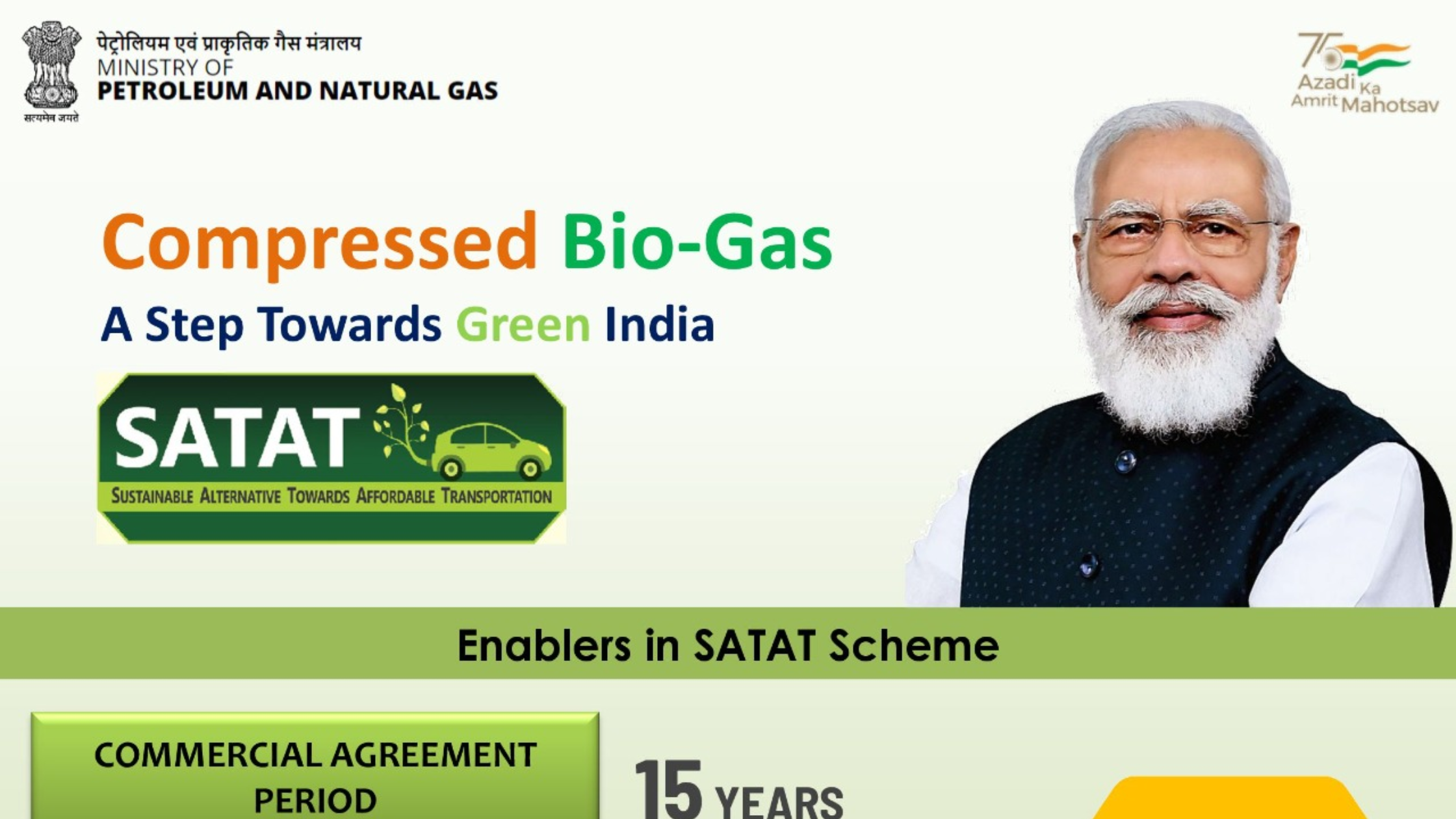
Under the SATAT scheme (Sustainable Alternative Towards Affordable Transportation), launched by the Ministry of Petroleum and Natural Gas in October 2018, the target is to set up 5,000 CBG plants across the country and produce 15 Million Metric Tonnes of CBG per annum. The plants are intended to be run by independent entrepreneurs — not PSUs — and the produced gas is purchased by Oil Marketing Companies (OMCs) like IOCL, BPCL, HPCL, and GAIL under long-term Letters of Intent.
To put that in economic terms: the envisaged investment across these 5,000 plants is roughly ₹2 lakh crore.
And the policy floor has only strengthened in recent months. A phased mandatory blending obligation now requires CBG to be progressively blended into CNG (Transport) and PNG (Domestic) segments of the CGD network — meaning the offtake demand is no longer a hope, it is a regulatory requirement.
So the demand side is set. The buyers are PSUs. The blending is mandated. The pricing is supported. On paper, this should be one of the cleanest infrastructure opportunities of the decade.
Then why are fewer than 200 plants actually commissioned against 1,000+ Letters of Intent issued?
What the Government Has Actually Put on the Table
A surprising number of CBG promoters we speak to have only partial knowledge of the subsidy stack. Some know about SATAT but not about MNRE’s Central Financial Assistance. Some know about the capital subsidy but haven’t heard of the biomass aggregation machinery grant. Some have no idea their project qualifies for Priority Sector Lending.
Here is the consolidated picture, in plain English.
1. Central Financial Assistance (CFA) from MNRE — Up to ₹10 Crore Per Project
Under the Waste to Energy Programme of the Ministry of New and Renewable Energy, a capital subsidy of ₹4 crore is available for every 4,800 kg of CBG produced per day (equivalent to 12,000 cubic metres of biogas per day), subject to a ceiling of ₹10 crore per project.[2][5]
Important nuance most promoters miss: this CFA is released to the lender’s loan account after successful commissioning and Commercial Operation Date (COD) — not before. In other words, the subsidy reduces your outstanding loan after the plant is up and running. It does not directly fund construction. Which means you still need someone to finance the construction in the first place — and that is where most projects hit a wall.
2. Priority Sector Lending (PSL) Status
The Reserve Bank of India has classified loans of up to ₹50 crore to start-ups setting up CBG plants as Priority Sector Lending.[6] Banks are therefore supposed to extend credit to CBG projects on preferential terms.
In practice, the gap between policy and execution is wide. As one CBG entrepreneur publicly observed, despite PSL designation, banks continue to hesitate on CBG loans — citing uncertainty about sector viability, bankability of offtake, and unfamiliarity with biogas project cash flows.[7] This is not a failing of PSL; it is a failing of information flow between lenders and project developers. We’ll come back to this.
3. Biomass Aggregation Machinery (BAM) Subsidy
One of the most under-used schemes. The government provides a 50% subsidy on biomass aggregation machinery, up to a ceiling of ₹90 lakh per set, for eligible CBG producers using at least 50% agri-residue as feedstock and with a capacity of 2 TPD or more.[8] Feedstock logistics are among the biggest operational headaches for CBG plants — this subsidy directly attacks that problem.
4. SATAT Price Support and Guaranteed Offtake
Under SATAT, OMCs have committed to long-term procurement of CBG at a notified price — reducing revenue uncertainty and creating a bankable offtake profile.
5. Agri Infrastructure Fund (AIF)
Administered by the Ministry of Agriculture and Farmers’ Welfare, the AIF offers loans for post-harvest infrastructure with a 3% per annum interest subvention for loans up to ₹2 crore — usable for certain CBG-linked investments.
6. Carbon Credit Eligibility
CBG has been notified as one of the approved sectors under Phase I of India’s Carbon Credit Trading Scheme, administered by the Bureau of Energy Efficiency.[9] For a well-run plant, carbon credit revenue can add meaningfully to project IRR.
7. State-Level Incentives
Layered on top of the central stack, several states offer additional interest subventions, concessional land allotment, and electricity subsidies. Gujarat, for example, has offered interest subsidy on term loans for biogas projects; Punjab has supported feedstock collection logistics. Stacking central + state benefits is often the difference between a marginal project and a comfortably bankable one.
So Why Are Projects Still Stuck?
This is the question we started CleanTechFin to answer honestly.
From our conversations with promoters, lenders, and consultants, four problems keep surfacing:
First, awareness is fragmented. Most builders know one or two schemes, not the full stack. Many have never heard that the CFA is released post-commissioning (a crucial cash-flow fact). Many do not know that the RBI’s PSL inclusion gives them negotiating leverage with their bank.
Second, bankers treat CBG as an unfamiliar sector. Industry reporting has noted that banks typically expect higher equity contributions, significant collateral, and strong promoter track record before funding CBG — reflecting discomfort with a sector where projects often operate below optimal capacity and revenue from by-products like fertiliser or carbon credits remains uncertain.[10] Interest rates for CBG projects typically land around 9%, with lenders looking for project IRRs of around 15% to consider long-term viability.[10]
Third, capex estimates vary wildly. A 10 TPD plant can be set up anywhere between ₹40 crore and ₹80 crore depending on technology — a range that makes standardised due diligence hard and lender confidence harder.[10]
Fourth — and this is the quiet killer — there is no single window that aggregates subsidy processing, bank introductions, DPR preparation support, and LoI documentation. Promoters end up running from MNRE portals to bank branches to OMC tender windows to state nodal agencies, often with incomplete documentation, and often losing months.
Where CleanTechFin Fits In
CleanTechFin (cleantechfin.altfortcapital.com) is a platform built by AltFort Capital to sit precisely in that gap — between the CBG builder and the capital stack.
We are not a bank. We are not a government portal. We are a purpose-built financing intermediary for the compressed biogas sector, and our role is simple:
- We help you structure the project to be bankable — from DPR preparation to capex benchmarking, so your project file does not get rejected on avoidable grounds.
- We help you access the full subsidy stack — CFA, BAM, state incentives, AIF — rather than claiming one and missing three.
- We connect you to the right lenders — institutions that actually understand CBG (IREDA, NABARD, specific commercial banks with active CBG books) rather than generic branch-level approaches that stall for months.
- We help you close the capital structure — blending debt, equity, subsidy, and where relevant, carbon-credit-linked instruments.
In a sector where SATAT has envisaged ₹2 lakh crore of investment and less than 5% of the plant target has been commissioned, the bottleneck is not ambition. It is financial intermediation. That is the problem we are here to solve.
What You Can Expect from This Blog
Over the coming weeks, we will be publishing deep-dives on:
- How to prepare a CBG DPR that banks actually approve
- A comparative breakdown of IREDA vs. commercial bank vs. NABARD financing for CBG
- State-wise incentive stacks — Gujarat, Punjab, UP, Maharashtra, Karnataka
- The carbon credit opportunity: how VCS and Gold Standard pathways can add 8–12% to your project revenue
- Offtake strategy: navigating OMC LoIs, pricing protection, and CGD injection
- Feedstock risk: how plants have solved the paddy straw and cattle dung sourcing problem
Our intent is simple — to make sure that by the time you walk into a bank branch, you are speaking the same language they are.
A Final Word
The CBG sector is at a genuine inflection point. Mandatory blending has removed the offtake question. Budget 2026 removed the excise duty on the biogas portion of blended CNG, eliminating a double-taxation overhang that had hurt plant economics.[11] The subsidy architecture is more mature than it has ever been.
What remains is execution — and execution, in this sector, is almost entirely a financing problem.
If you are a CBG builder who feels the policy has opened doors but the bankers keep them closed, you are not alone. Talk to us.
Footnotes and Citations
[1] Indian Oil Corporation Limited, SATAT Overview, iocl.com/pages/satat-overview. The SATAT scheme was launched on 1st October 2018 by the Ministry of Petroleum and Natural Gas, and the National Biofuels Coordination Committee has approved phase-wise mandatory blending of CBG in CNG (Transport) and PNG (Domestic) segments.
[2] Ministry of New and Renewable Energy, as reported via IOCL SATAT portal — Central Financial Assistance of ₹4 crore per 4,800 kg CBG per day, capped at ₹10 crore per project, under the Waste to Energy Programme.
[3] Press Information Bureau, Government of India, Release dated 8 December 2022 (PRID 1881749) — SATAT envisages 5,000 CBG plants producing 15 MMT per annum; investment envisaged at approximately ₹2 lakh crore.
[4] Renewable Watch, “Climate Action: ESG pathways to scale India’s CBG ecosystem,” 22 July 2025 — as of July 2025, 1,094 LoIs issued and 108 CBG plants commissioned under SATAT.
[5] Union Bank of India, Union CBG Scheme for Compressed Bio Gas Units — CFA disbursal mechanism and eligibility under SATAT.
[6] IREDA (Indian Renewable Energy Development Agency), Compressed Bio-Gas Financing, ireda.in/access-to-energy — RBI notification bringing CBG start-up loans up to ₹50 crore under Priority Sector Lending.
[7] India Business and Trade, interview with Chandrasekar N., Founder, Jivoule Biofuels, August 2023 — on the gap between PSL designation and actual bank willingness to lend.
[8] Government of India notification on Biomass Aggregation Machinery subsidy — 50% of cost or ₹90 lakh per set, whichever is lower, for eligible CBG producers using at least 50% agri-residue feedstock.
[9] Renewable Watch, “Climate Action: ESG pathways to scale India’s CBG ecosystem,” 22 July 2025 — on AIF interest subvention and Carbon Credit Trading Scheme eligibility for CBG.
[10] Renewable Watch, “Unlocking Capital: Risks and returns in India’s CBG financing landscape,” 22 July 2025 — on capex variation, lender risk appetite, typical interest rates (~9%) and expected IRRs (~15%).
[11] Industry reporting on Union Budget 2026 treatment of excise duty on the biogas component of blended CNG.